
By The Digital Marketing Media
For years, video marketing was treated as a “nice-to-have.” Something brands experimented with if they had the budget, the time, or the confidence to be on camera.
That era is over.
Today, video marketing is no longer optional — not because it’s trendy, but because it fundamentally changes how people make decisions online. Attention, trust, and clarity now move at the speed of video. Businesses that embrace this reality grow faster. Businesses that ignore it slowly disappear.
But here’s the uncomfortable truth:
Most businesses using video are still doing it wrong.
They post inconsistently. They chase virality. They treat video like entertainment instead of infrastructure. And then they wonder why the views don’t turn into leads, calls, or revenue.
At The Digital Marketing Media, we approach video differently. We don’t see it as content for content’s sake — we see it as a trust and demand accelerator inside a larger system.
This article breaks down why video marketing is now mandatory and, more importantly, how businesses should actually use it if they want results.
Why Video Now Sits at the Center of Modern Marketing
Every major platform has already made the decision for you.
- Social platforms prioritize video over static content
- Paid ads reward video with lower costs and higher engagement
- Search engines increasingly surface video in results
- Consumers trust faces and voices more than text and graphics
This isn’t a coincidence. It’s behavioral.
People don’t read anymore — they scan. They don’t compare long explanations — they look for signals. And they don’t trust brands that hide behind stock photos and generic messaging.
Video compresses trust.
In seconds, it answers unspoken questions:
- Is this business legitimate?
- Do they know what they’re talking about?
- Can I trust them?
- Do I feel comfortable reaching out?
Text can explain. Video convinces.
The Biggest Lie About Video Marketing
The most damaging misconception in digital marketing is this:
“We just need to post more videos.”
Volume without structure doesn’t build trust — it creates noise.
Many businesses jump into video by:
- Posting random reels
- Copying trends that don’t fit their brand
- Chasing views instead of clarity
- Treating video as a standalone tactic
The result? Attention with no direction.
Video works when it’s intentional, not when it’s impulsive.
What Video Is Actually Meant to Do
Video marketing has three real jobs:
1. Build Trust Faster Than Any Other Medium
Trust is the bottleneck in almost every buying decision.
Before someone fills out a form, books a call, or picks up the phone, they want reassurance. Video humanizes your brand in a way nothing else can.
A single well-structured video can outperform:
- Ten written posts
- Multiple testimonials
- A perfectly designed website
Because people trust people — not logos.
2. Shorten the Decision-Making Process
Good video doesn’t just inform — it pre-sells.
It addresses objections before they’re voiced:
- “How does this work?”
- “Is this right for me?”
- “Why should I choose you?”
When video is used correctly, leads come in warmer, more educated, and more confident.
3. Support Every Other Marketing Channel
Video isn’t a replacement for marketing — it’s a multiplier.
It strengthens:
- Social media engagement
- Paid ad performance
- SEO rankings and dwell time
- Landing page conversion rates
This is why we treat video as a core asset, not a side project.
Short-Form vs. Long-Form Video: Where Businesses Get Confused
Not all video has the same job.
Short-Form Video (Reels, Shorts, TikToks)
Short-form video is designed for:
- Awareness
- Attention
- Pattern interruption
- Quick trust signals
It answers one question:
“Should I care enough to learn more?”
Short-form video works best when it:
- Educates quickly
- Calls out common mistakes
- Simplifies complex ideas
- Shows authority without selling
Long-Form Video (YouTube, Podcasts, Explainers)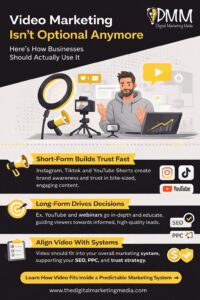
Long-form video is where authority compounds.
This is where you:
- Explain your philosophy
- Teach your process
- Break down systems
- Differentiate from competitors
Long-form content turns viewers into believers.
The mistake businesses make is choosing one instead of using both strategically.
Video Without a System Is Just Noise
This is where most marketing breaks down.
Businesses create video in isolation instead of aligning it with:
- Messaging
- Offers
- Paid campaigns
- SEO strategy
- Conversion paths
At The Digital Marketing Media, video is deployed inside our proprietary framework — the Demand Precision Matrix™.
That means every video has a purpose:
- Awareness videos introduce problems
- Authority videos establish credibility
- Trust videos remove objections
- Conversion videos guide action
When video supports a system, results become predictable.
When it doesn’t, it becomes content for content’s sake.
The Types of Videos Every Business Should Be Creating
You don’t need fancy production.
You need clarity and consistency.
Here are the core video categories we recommend:
1. Educational Videos
Teach what your audience doesn’t know — or thinks they know but doesn’t.
Education builds authority faster than promotion.
2. Process & Philosophy Videos
Explain how you think.
These videos separate professionals from amateurs.
3. Objection-Handling Videos
Address the reasons people hesitate:
- Cost
- Time
- Skepticism
- Past bad experiences
4. Proof-Based Videos
Show outcomes, stories, and real-world examples.
People believe what they can see.
5. Conversion Support Videos
Not hard sells — guidance.
Clear next steps reduce friction.
Why “Authentic” Doesn’t Mean Unstructured
Another myth is that video needs to be completely off-the-cuff.
Authenticity matters — but clarity matters more.
The best-performing videos are:
- Natural, not scripted
- Clear, not rambling
- Intentional, not random
Preparation isn’t fake. It’s professional.
How Video Impacts SEO and Paid Ads
Video isn’t just social content — it’s a performance asset.
Video & SEO
Video increases:
- Time on page
- Engagement signals
- Content depth
Search engines reward pages that keep users engaged.
Learn more about how video supports long-term rankings through SEO strategies that convert.
Video & Paid Ads
Video ads:
- Capture attention faster
- Lower cost per click
- Build familiarity before conversion
But only when paired with strategy.
See how we integrate video into paid advertising systems that drive real results.
The Real Advantage of Video in 2026 and Beyond
The advantage isn’t views.
It’s familiarity.
When prospects feel like they already know you:
- Price becomes less of a factor
- Trust forms faster
- Decisions happen sooner
Video creates that familiarity at scale.
Recent Comments